
Trade Secret Protection for Jaipur Manufacturers: A Guide
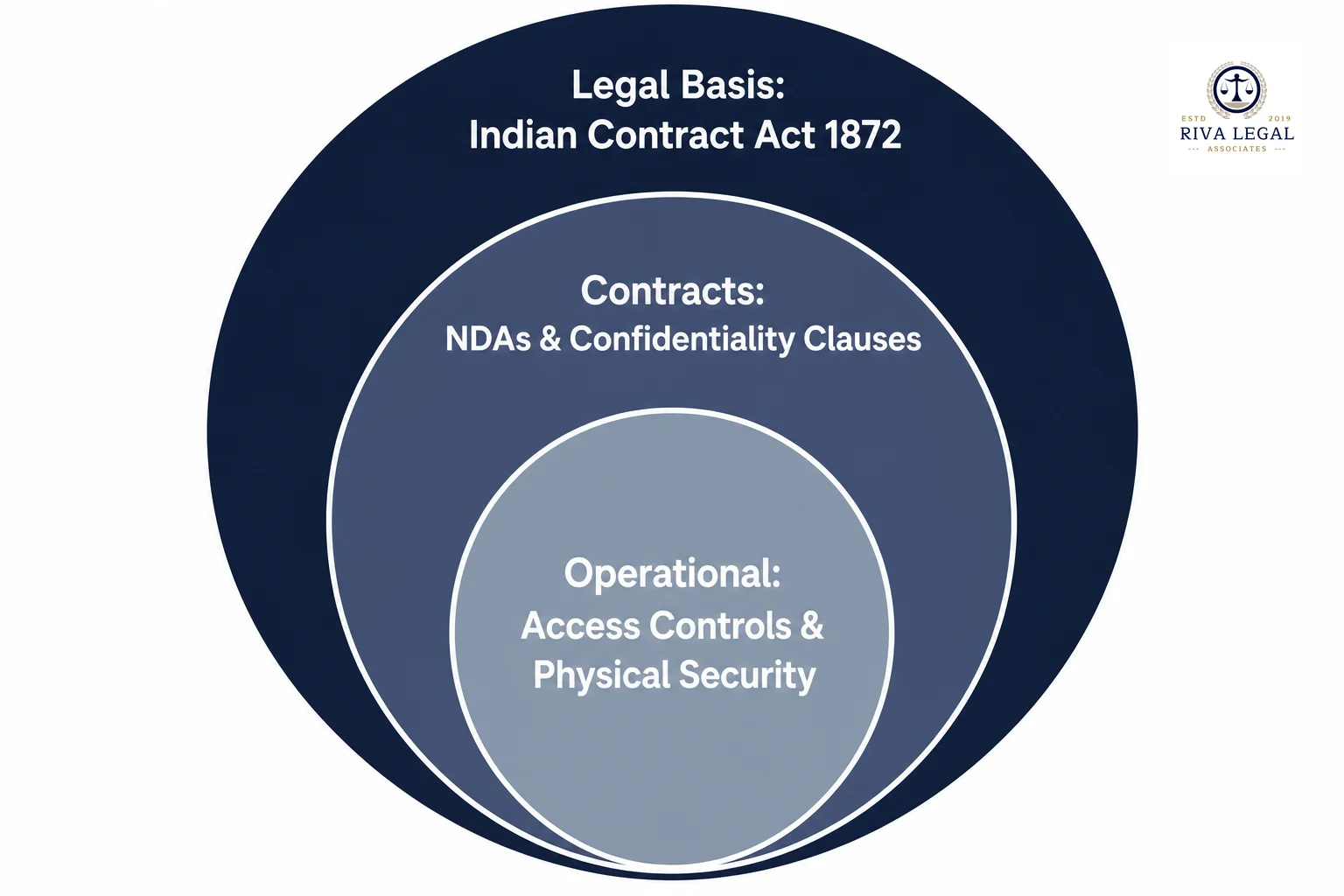
Trade secret protection for Jaipur manufacturing businesses rests on contract and common law. India has no standalone trade secrets statute. A manufacturer protects its formulas, process settings and supplier data in two ways. First, it uses written confidentiality rules under the Indian Contract Act, 1872. Second, it adds practical access controls on the factory floor.
Key Takeaways
- No dedicated statute: India protects trade secrets through contract law, the law of confidence, and limited common-law remedies. There is no specific trade secrets act.
- Contracts do the heavy lifting: Enforcement usually depends on a clear confidentiality clause or NDA. The value of the information alone is not enough.
- Reasonable steps matter to courts: Access limits, marked documents and clear confidentiality duties support a case. Their absence weakens it.
- Third parties are a distinct risk in Rajasthan's manufacturing clusters: job-workers, contract manufacturers and vendors often see more of a process than employees do.
- Employee exit is a separate topic: this guide covers ongoing operational protection. Exit-specific steps are covered in Employee Exit Checklist: How to Protect Trade Secrets in India.
At a Glance: Trade Secret Protection Basics
| Aspect | Position in India |
|---|---|
| Governing law | Indian Contract Act, 1872; common-law breach of confidence; Specific Relief Act, 1963 for injunctions |
| Dedicated statute | None currently in force; a draft Protection of Trade Secrets Bill has been discussed but not enacted |
| Primary protective tool | Written confidentiality clause or standalone NDA |
| Typical duration of obligation | Set by contract; often 2-5 years post-termination, sometimes indefinite for formulas |
| Who typically needs coverage | Employees, job-workers, vendors, contract manufacturers, consultants |
| Court remedy on breach | Injunction, damages, account of profits, depending on relief sought |
| Registration required | No, unlike patents, trademarks or designs |
What Counts as a Trade Secret in a Manufacturing Business?
A trade secret in a factory is any confidential information that gives the business an edge over rivals and is not widely known outside it. In Jaipur's gems and jewellery, textile printing, handicraft export and light engineering clusters, this often includes dyeing formulas, alloy mixes, die and tooling drawings, machine settings, and vendor or client pricing.
Three things generally need to be true for information to qualify. It must be confidential. It must have commercial value because it is secret. And the owner must take reasonable steps to keep it that way. Courts weigh that third point carefully. A formula written on a whiteboard that every visitor can see makes a weak case. A formula stored under restricted access with a signed confidentiality agreement makes a much stronger one.
Why Jaipur and Rajasthan Manufacturers Face Particular Exposure
Family-run manufacturing units across Rajasthan often outsource stages of production. This is common in jewellery, handicrafts, textiles and metal fabrication. They rely on job-workers and small contract manufacturers. That structure spreads process knowledge across many hands, not just full-time employees.

Many of these businesses have no in-house legal support. They rely on informal trust with long-standing job-workers instead of written agreements. That gap only becomes visible when a relationship ends badly. At that point, there may be no signed document to point to. Unwritten trust works fine until it doesn't, and by then the secret has usually already moved.
1. Identify and Classify What Needs Protection
Start with an inventory. List every process, formula, drawing, supplier contact and pricing structure that would help a competitor if it leaked. Not everything deserves the same level of protection.
- Tier 1 (core know-how): formulas, proprietary process parameters, master tooling designs.
- Tier 2 (operational): supplier lists, cost structures, internal quality benchmarks.
- Tier 3 (routine confidential): internal reports, draft designs not yet finalised.
This tiering matters. It decides who gets access, what a confidentiality clause must cover, and how strict physical controls should be. Treating a routine memo like a proprietary alloy formula wastes resources without adding real protection.
2. Build the Contractual Layer: NDAs and Confidentiality Clauses
Contract is the main legal basis for trade secret protection in India. The Indian Contract Act, 1872 supplies the enforceable duty that a standalone trade secrets law would otherwise provide. Every employee, vendor, job-worker and consultant who touches confidential information should sign a written agreement. That agreement should stop them using or sharing the information beyond its agreed purpose.

A confidentiality clause or standalone NDA needs a few things. It should define what counts as confidential information. It should state the allowed purpose of disclosure. It should fix a time limit for the duty, including a period after the relationship ends. And it should carve out information that is already public or was developed independently. It should also name the remedy sought on breach, since courts treat an injunction (a court order to stop an action) and damages differently.
Under the Indian Contract Act, 1872, courts have recognised confidentiality obligations as enforceable contractual terms, and breach can support a claim in damages or an injunction under the Specific Relief Act, 1963. See analysis at Beacon Filing's guide on trade secret protection in India.
Businesses without in-house legal help often draft these clauses informally, or copy a template found online. These templates frequently miss the carve-outs or the post-termination time limit. An independent legal review before signing can catch gaps like these.
3. Put Physical and Digital Access Controls in Place
A signed NDA loses its force in court if the information was never actually kept confidential in practice. Physical steps matter. Restrict factory floor access to areas where core processes run. Log visitors. Mark sensitive documents and drawings as confidential.
Digital steps need the same discipline. Restrict drawings and formula files to named roles. Avoid sending process documents over personal messaging apps. Keep a record of who accessed what, and when. None of this costs much to set up. And it is exactly the evidence a court looks for when deciding whether "reasonable steps" were actually taken.
4. Manage Third Parties: Job Workers, Vendors and Contract Manufacturers
Job-work is common across Rajasthan's manufacturing base. It is also where confidentiality most often breaks down. A job-work agreement should include three things: a confidentiality clause covering the specific process shared, a non-use restriction limiting the job-worker to the agreed task, and a return-or-destroy duty for drawings and samples once the work ends.
Vendor vetting matters too. A supplier who has worked with a competitor before is not automatically a risk. But the confidentiality terms in that vendor's contract deserve a closer look before sensitive specifications are shared.
How Do Indian Courts Enforce Trade Secrets Without a Dedicated Statute?
Indian courts enforce trade secrets through three routes: breach of contract claims, the equitable action for breach of confidence, and injunctions under the Specific Relief Act, 1963. There is no dedicated trade secrets statute to fall back on. The strength of a claim depends heavily on whether the business can show a clear confidentiality duty and reasonable protective steps.
A court asked to stop a former job-worker or employee from using disclosed information will look at three things. Was the information genuinely secret? Was it shared under a duty of confidence? And does the defendant's use go beyond that duty? Without a written agreement, a claimant must rely on the more uncertain common-law action for breach of confidence, which is harder to prove and slower to resolve. For more on this framework, see Altacit's overview of IP protection for manufacturing companies in India.
Employee-Specific Risk: A Separate Process
Everything above covers ongoing, day-to-day protection across a manufacturing operation, whether the person handling confidential information is an employee, a vendor, or a job-worker. The moment an employee's relationship with the business actually ends, a different and more urgent set of steps applies. These cover exit interviews, device return, access revocation and reminder notices.
That process is covered separately in Employee Exit Checklist: How to Protect Trade Secrets in India, which this guide does not repeat.
Where This Fits With Other IP in a Manufacturing Business
Trade secrets sit alongside other IP tools, not in place of them. An invention that meets the novelty and inventive-step tests under the Patents Act, 1970 is usually better protected through a patent filing. A granted patent gives exclusive rights that a trade secret cannot. See Patent Filing Cost & Process in India 2026 for that process.
Product appearance, as distinct from the underlying process, falls under the Designs Act, 2000, not trade secret law. Design Registration in India: Protecting Product Aesthetics covers that route. Most manufacturers end up combining all three tools: patents for patentable inventions, design registration for product appearance, and trade secret contracts for process knowledge that is either unpatentable or that the business would rather keep confidential than reveal in a public patent filing.
Frequently Asked Questions
Is there a trade secrets law in India?
No standalone trade secrets statute exists in India as of 2026. Protection instead comes from the Indian Contract Act, 1872, the common-law action for breach of confidence, and injunctive relief under the Specific Relief Act, 1963. See Lexclaim's analysis of trade secret rights in India.
Can an NDA alone protect a formula?
An NDA is necessary, but rarely enough on its own. A written confidentiality clause sets out the legal duty. But courts also check whether the business actually kept the formula restricted in practice, through limited access, marked documents and controlled digital storage.
What happens if a job-worker leaks a process?
If the job-work agreement has a confidentiality clause, the business can bring a breach of contract claim. It can seek an injunction to stop further use, plus damages for the loss suffered. Without a written agreement, the business must rely on the less certain common-law breach of confidence action. That route requires proving the information was shared under an implied duty of confidence.
Does registering a patent instead of keeping a trade secret make sense for a manufacturing process?
It depends on two things: whether the process meets patentability standards, and whether the business is willing to disclose it publicly in exchange for time-limited exclusive rights. A process that is hard to reverse-engineer from the finished product, such as an internal formula, is often kept as a trade secret. Why? Because patent disclosure would reveal it to competitors once the patent term ends.
This content is published for general information only. It is not legal advice, an advertisement, or a solicitation of work, and reading it does not create an advocate-client relationship. In keeping with the Bar Council of India Rules, Riva Legal Associates does not solicit work or advertise.