
Copyright for AI-Generated Content in India: What the Law Currently Says
The Copyright Act, 1957 has no provision that expressly deals with works generated by artificial intelligence, so copyright for AI-generated content in India depends on how existing rules on originality, authorship and first ownership are applied. Courts have not yet settled the point. This guide, written from Riva Legal Associates' chambers in Jaipur, sets out what is reasonably clear and what remains open.
Riva Legal Associates is a boutique intellectual property practice established in 2019. Copyright is one of the areas of law we practise, alongside patents, trade marks, designs, geographical indications and trade secrets. The aim here is general information for creators, entertainment companies and software teams that use generative tools.
Is AI-generated content protected by copyright in India?
Section 2(d)(vi) of the Copyright Act, 1957 is the computer-generated works limb. It says the author, "in relation to any literary, dramatic, musical or artistic work which is computer-generated, the person who causes the work to be created". The Act does not say whether a person who prompts a generative tool "causes" the work, and no court has settled it.
Not clearly. Indian law protects original works and links authorship to a person, while the Act does not expressly recognise works generated by AI. Output with real human creative input is on firmer ground than output produced by a tool with little human direction. No court has laid down a definitive rule.
The Indian Copyright Act does not explicitly recognise works generated with the assistance of AI, as an NLS Forum analysis notes. Commentators also point out that Indian courts have not yet clarified how the "computer-generated" provision applies to generative AI, which leaves uncertainty for creators.
In practice, "AI-generated" covers very different situations. A designer who sketches a concept, generates variations with a tool and then reworks the result stands in a different position from someone who types one prompt and publishes the first image. The law's answer is likely to differ for each.
What does the Copyright Act, 1957 say about authorship and ownership?
The Act protects original literary, dramatic, musical and artistic works, cinematograph films and sound recordings. The author is generally the person who creates the work, and that person is usually its first owner, unless employment or a contract provides otherwise. For computer-generated works, the Act names "the person who causes the work to be created".
Subsistence and originality
Copyright subsists in original literary, dramatic, musical and artistic works, and in films and sound recordings (Section 13). Courts require originality. In Eastern Book Company v. D.B. Modak (2007), the Supreme Court described it as independent creation with a minimum level of skill and judgment, rather than mere effort.
That standard matters for AI work. The question is whether a human exercised creative skill and judgment in the finished piece, not simply whether a tool produced something that looks original.
Authorship and first ownership
Section 2(d) defines "author" by type of work. For literary, dramatic, musical and artistic works, it is the person who creates the work. For films and sound recordings, it is the producer. The Act also has a specific limb for computer-generated works, which names the person who causes the work to be created. An Alliance University centre blog notes that AI has no legal personality, so it cannot be an independent author.
On ownership, Section 17 provides that the author is the first owner unless a contract says otherwise, and it has separate rules for employment and certain commissioned works. An NLS Forum article reads Section 17 as leaving first ownership with the human individual absent a contrary contract.
The "person who causes the work to be created"
This phrase dates from 1957, long before generative AI. It could point to the person who writes the prompts, the person who built or trained the system, or the business that deploys it. The text does not say which, and Indian courts have not ruled on it for generative tools.
How does AI involvement affect who owns a work?
The more a human shapes the final work through selection, arrangement, editing and original contribution, the stronger the case for treating that person as author and first owner. Where output comes almost entirely from the tool, the question of who "caused" the work, and whether it is original at all, becomes harder.
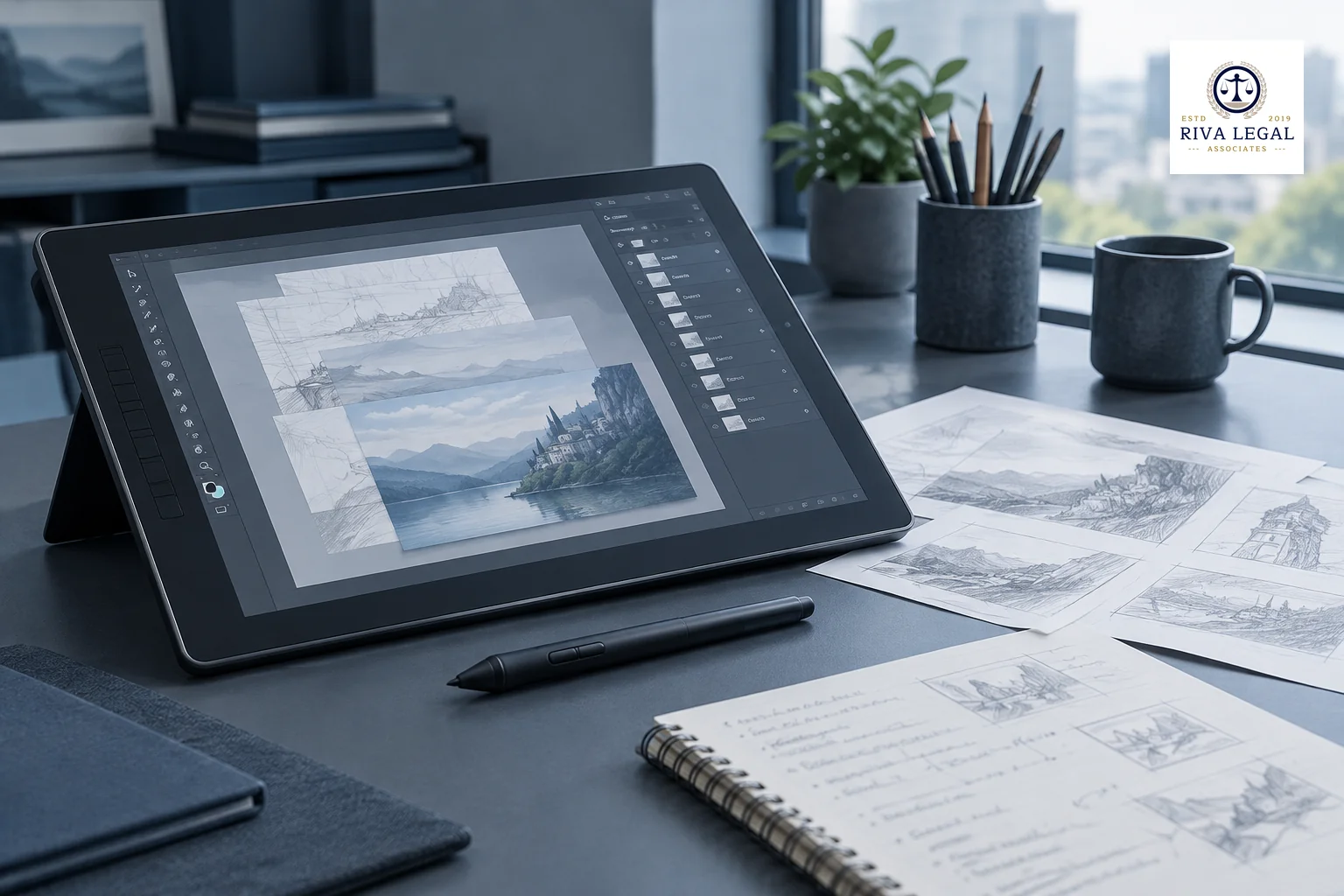
One line of academic commentary proposes a "significant human input" approach, under which protection follows meaningful human contribution. It is a proposal in the literature, not a rule laid down by Indian courts or the legislature. The table below sets out common scenarios and the questions each raises. It is a map of issues, not a prediction of outcomes.
| Scenario | Question that arises | What is worth checking |
|---|---|---|
| AI used as a drafting or editing aid, with substantial human rewriting | Is the final work an original human work? | Records of human edits, selection and arrangement |
| Human-created base work (a sketch or script) extended by a tool | Which parts are human, which are generated? | Dated originals and version history |
| Output from a single prompt, published unchanged | Is there originality and a human author at all? | Whether the "person who causes the work" provision could apply |
| Employee uses a tool in the course of employment | Does the employer take first ownership? | Employment terms and company tool policy |
| Freelancer or agency delivers AI-assisted work | Can the client take ownership by assignment? | Assignment wording and disclosure of AI use |
Employees, contractors and commissioned work
A 2026 academic paper on authorship and ownership of generative AI works observes that where a commissioned person uses an AI system, the employer or commissioning party may take first ownership, but only once the relevant statutory conditions are met. That is why contracts for creative and software work deserve a fresh look.
Standard assignment clauses were usually written on the assumption that a human produced every element. They may not say what happens to material generated by a tool, or who bears the risk if that material resembles someone else's work.
Hypothetical: an agency's AI-assisted poster
Suppose an agency's designer writes a prompt, generates four images, picks one, redraws the face and lettering by hand and arranges it in a layout. The agency then assigns the poster to a client.
Originality: the redrawing, selection and layout show human skill and judgment, so the finished poster is more likely to meet the Eastern Book Company standard than the raw output would. The untouched generated elements are less certain.
Authorship: the designer is the likely author of the human contribution. Whether Section 2(d)(vi) also applies to the generated parts is open.
Ownership: if the designer is an employee, the employer is likely first owner under Section 17, subject to its conditions. The agency can then assign to the client. Tentative conclusion: protection is reasonably arguable for the human-shaped poster, weaker for the raw image, and the assignment should say so.
Sample AI-use clause outline for assignment agreements
- Disclosure: the assignor lists any AI tools used and which parts of the work they produced.
- Human contribution: the assignor confirms and records its human creative input.
- Assignment: all rights the assignor holds in the work, including in human-contributed parts, pass to the assignee.
- Tool terms: the assignor confirms use complies with the tool's terms of service.
- Similarity warranty and indemnity: allocation of risk if output resembles an existing work.
- Records: the assignor keeps prompts and dated versions and provides them on request.
Terms of the tool itself
Platform terms of service are a separate layer. They may allocate rights in output between the user and the provider, restrict commercial use, or limit what the provider promises. These terms are contractual, and they cannot create copyright where the Act does not give it. They can, however, affect what a business is permitted to do with the output.
What does registration ask, and how does it relate to AI-assisted works?
An application to the Copyright Office is made on a prescribed form that asks for details of the work, its author and the claimant. A registration is recorded on the Register of Copyrights. It does not decide, by itself, whether an AI-assisted work is original or who its true author is.
The NLS Forum article noted above points out that the registration application (Form XIV) requires disclosure of the claimant's name and nationality, among other particulars.
The fields on author, claimant and nature of the work are where AI involvement should be described accurately, for example by naming the human author and stating which parts were human-created. Applicants should therefore be able to explain accurately who authored the work and how. Our guide to copyright registration in India covers the general procedure.
The Copyright Office website is the official resource for forms and procedure. Whether the registry will accept, query or refuse applications that describe AI involvement is not something this article can state, and practice may change as the law develops.
Open questions businesses using generative tools should track
Several questions remain unsettled. They cover who is the author of generative output, whether training on protected works is permitted, whether outputs can infringe existing works, and how any licensing or royalty scheme might work. Policy proposals exist, but none is law yet.
Interpretation of the computer-generated works provision
The central open question is whether the "person who causes the work to be created" language extends to generative AI, and if so, to whom. Until a court or Parliament speaks, businesses are working from an uncertain text. Treat any firm statement that AI output is "fully owned" or "never protected" with caution.
Training data and fair dealing
Copyright prohibits copying, save where the use falls within the statutory exception of fair dealing, and, as the NLS Forum piece observes, the term is nowhere defined in the Act.
Whether using protected works to train a model fits within it has not been settled by the Indian courts. The Government has flagged the issue: a February 2024 PIB release discusses the exclusive rights of owners, including reproduction and adaptation, and the question of permissions for commercial use.
The DPIIT working paper and proposed licensing
In December 2025, the Department for Promotion of Industry and Internal Trade (DPIIT) published Part 1 of a working paper on generative AI and copyright, prepared by an eight-member committee. It floats a model in which, according to a PIB release, AI developers would receive a blanket licence for lawfully accessed content, with royalties payable only on commercialisation and rates set by a government-appointed committee.
This is a consultation proposal. It has not been enacted, and its final shape may differ. Businesses should follow it as a signal of policy direction, not rely on it as current law.
Output that resembles existing works
Even if a business owns what it generates, generated output may reproduce or closely resemble an existing protected work. Copyright infringement is judged on the work itself, however it was made. If a notice arrives, our note on enforcing a copyright infringement notice in India explains how such notices work.
Practical record-keeping for creators, entertainment and software teams
Whatever the law eventually says, teams can reduce uncertainty by documenting how work is made. Records of human contribution, tool terms and contractual allocation of rights are useful evidence whichever interpretation prevails. The steps below are general, and each business's circumstances differ.
- Keep a process log. Note which parts were drafted by a person, which were generated, and what edits followed. Save dated versions.
- Retain prompts and settings. They show the degree of human direction and the tool used.
- Read the tool's terms. Check who the provider says owns the output, whether commercial use is allowed, and what warranties, if any, apply.
- Update contracts. Employment, freelance and agency agreements may need clauses on AI use, disclosure, assignment of output and responsibility for similarity to existing works.
- Set an internal policy. Define which tools staff may use and for what, particularly for client work and core brand assets.
- Review software and licensing arrangements. Development teams using code-generation tools should look at how this interacts with their software licence agreements.
Matters of this kind can involve parties in several states. Our firm accepts matters across India, working with associated local counsel where required, and this is the usual position for courts and tribunals outside Rajasthan.
Why does independent legal advice on specific facts matter?
The answer to an ownership or infringement question depends on the facts: how the work was made, who made it, what contracts apply and which tool was used. The law on AI is also changing. General information cannot account for those details, so readers should take independent legal advice on their own situation.
Two businesses can use the same tool and reach different legal positions because their contracts, workflows and levels of human input differ. A policy proposal published today may also change before it is enacted. For these reasons, this article describes the general position and should not be read as an assessment of any particular work.
For primary material, readers can consult the text of the Copyright Act, 1957, the Copyright Office website, and the DPIIT and PIB publications referred to above.
This content is published for general information only. It is not legal advice, an advertisement, or a solicitation of work, and reading it does not create an advocate-client relationship. In keeping with the Bar Council of India Rules, Riva Legal Associates does not solicit work or advertise.