
GI Tags and Family Businesses: How to Register Geographical Indication in India
A cluster of blue pottery workshops on the outskirts of Jaipur has been producing the same glazed ceramic ware for close to a century, passed from grandfather to father to daughter within a handful of families. None of them ever registered anything. A trader two states away started selling machine-stamped ceramics under the same regional name, at a fraction of the price, and the original families had no formal document to point to when buyers began asking why the "real" version cost more. This is the exact gap that a geographical indication registration is built to close.
Understanding how to register geographical indication in India matters most for the businesses least likely to have in-house legal support: family workshops, artisan clusters, cooperatives and heritage brands built around a place-based product. This guide walks through eligibility, the application process under Indian law, and the documentation gaps that most often stall these applications before they reach the Geographical Indications Registry in Chennai.
What a Geographical Indication Actually Protects
A geographical indication, or GI, is a form of intellectual property recognised under the Geographical Indications of Goods (Registration and Protection) Act, 1999. It identifies a good as originating from a specific place, where a given quality, reputation or other characteristic of the good is essentially attributable to that geographical origin. Darjeeling tea, Kota Doria sarees, Blue Pottery of Jaipur and Bikaneri Bhujia are all registered examples that Indian readers will likely recognise.
A GI is different from a trademark in one important way. A trademark belongs to a single business or individual and distinguishes their goods from a competitor's. A GI belongs to a community or a defined group of producers in a region, and no single family or company can own it outright, even if that family has produced the good for generations. This distinction shapes almost everything about the application process, and it is the first thing family businesses need to understand before filing.
GI-eligible categories under Indian law fall into several classes: agricultural goods, natural goods, handicrafts, textiles, manufactured goods, and foodstuffs. A family-run spice blend, a regional handloom textile, a traditional sweet, or a locally quarried stone craft can all potentially qualify, provided the link to geography can be demonstrated and documented.
Who Can Apply: Eligibility for Family Businesses, Artisans and Cooperatives
This is where many family businesses hit their first obstacle. Under Section 11 of the GI Act, an application can be made by any association of persons, producers, organisation or authority established by law representing the interest of producers of the goods. A single family firm, trading alone under its own name, generally cannot file a GI application on its own behalf in the way it might file for a trademark.
In practice, this means:
- A family business that is part of a wider producer cluster usually needs to apply jointly, through a cooperative society, producer company, trust, or registered association that represents the broader group of producers in that region.
- Where no such association exists yet, forming one is often the necessary first step, not a side task.
- The application must show that the product's quality, reputation, or characteristic is essentially due to its geographical origin, not simply that the family has been making it for a long time.
- Once the GI is registered in the name of the association or authority, individual producers, including the family business itself, apply separately to become an Authorised User so they can legally use the GI logo and name on their goods.
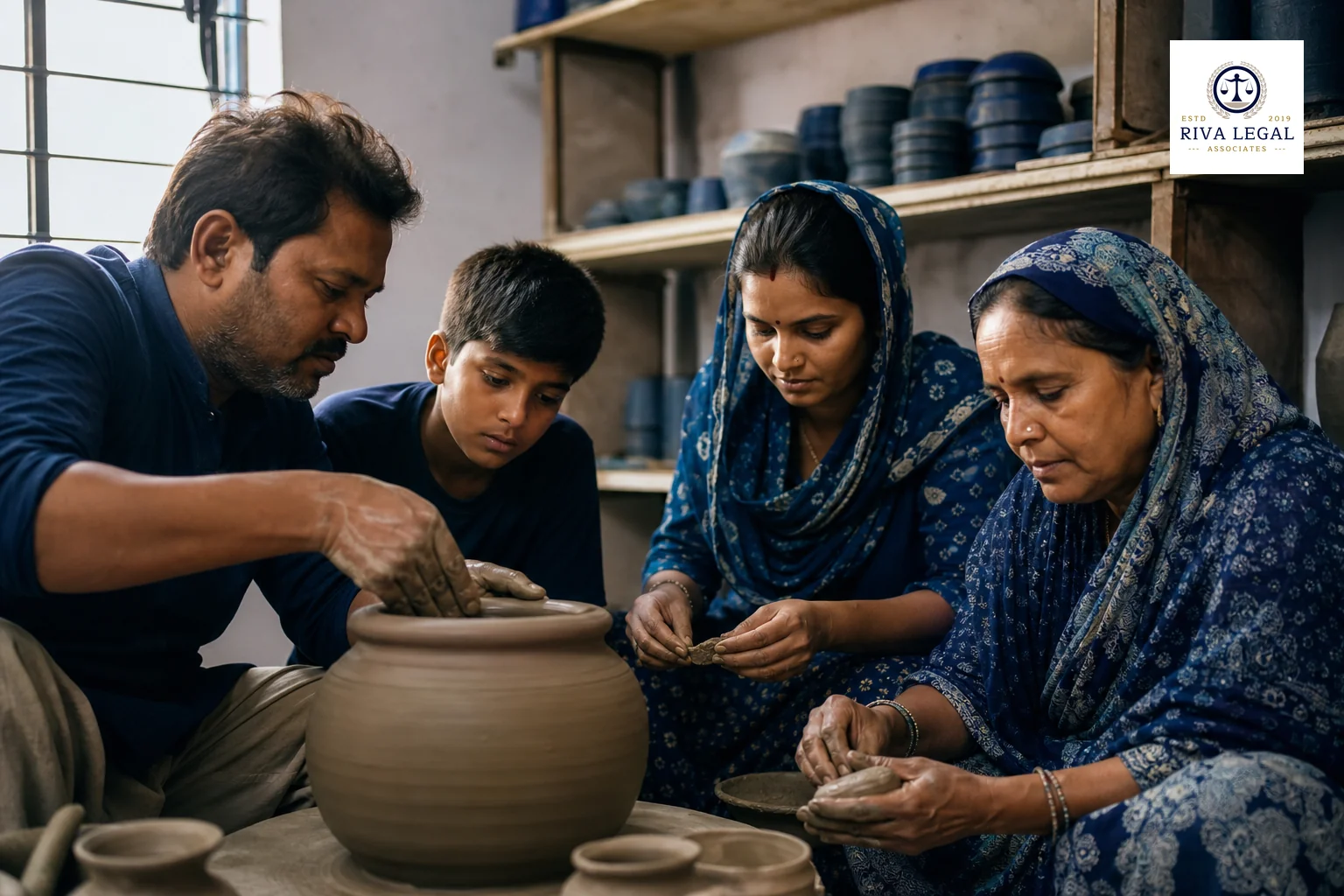
For a heritage brand that has always operated as a private family enterprise, this cooperative structure can feel unfamiliar. It is worth treating it as a governance decision as much as a legal one: who signs on behalf of the group, how future producers are added, and how quality standards are enforced across members. Firms advising on this stage often draw on experience structuring founding or governing agreements for group ventures, since a producer association benefits from clearly written internal terms just as a company would.
1. Establish the Link Between the Product and the Region
Before any form is filed, the strongest applications start with evidence. The Registry wants to see that the good's quality, reputation, or a defining characteristic is genuinely tied to the place it comes from, whether through soil composition, climate, water source, or a traditional method or skill passed down within that geography.
Useful sources of proof include:
- Gazetteers, revenue records, or district administrative reports that mention the product historically
- Trade body records, export data, or industry association documentation
- Photographs, family production records, or oral history transcripts showing continuity of the craft or method
- Scientific or technical reports explaining why the local soil, water, climate or raw material affects the final product
This body of evidence becomes the backbone of the Statement of Case, a mandatory part of the GI application that sets out exactly why the product deserves protection tied to that region. Family businesses frequently underestimate how much documentation this requires, especially when the knowledge has always been informal, passed down verbally rather than recorded.
2. Form or Identify the Applicant Association
If a formal producer association, cooperative, or trust does not already exist for the product category, this needs to be set up before, or alongside, the GI filing. Depending on the community's structure, this could take the form of:
- A registered cooperative society under the relevant state cooperative societies act
- A producer company under the Companies Act, 2013
- A trust or society formed specifically to represent the interests of the region's producers
- An existing trade or industry association whose objectives already cover representing producers of the good
This step is, in practical experience, the single biggest documentation gap for artisan clusters and family units pursuing GI protection. Families that have always operated independently, sometimes even competing with neighbouring workshops for the same buyers, are suddenly asked to formally organise and speak with one voice for the purpose of the application. Getting this structure right, with clear membership criteria and a defined decision-making process, tends to determine how smoothly the rest of the filing proceeds.
3. Prepare the Application and Supporting Documents
The formal application is filed as Form GI-1 with the Geographical Indications Registry, which operates from the Intellectual Property Office in Chennai under the Controller General of Patents, Designs and Trade Marks. You can review the Registry's current procedures and forms on the Office of the Controller General of Patents, Designs and Trade Marks website.
A complete application typically includes:
- The Statement of Case establishing the geographical link, historical evidence, and reputation of the good
- Class of goods under which registration is sought, following the GI classification system
- A geographical map of the region or area to which the GI relates, with boundaries clearly defined
- Particulars of the producers, including names and addresses of the association's members claimed to be producers of the good
- An affidavit from the applicant explaining how it represents the interest of the producers of the concerned goods
- A specification describing the standards, methods of production, and quality benchmarks that define the authentic product

The most common documentation gaps at this stage are a vague or overly broad geographic boundary, a producer list that is incomplete or informally maintained, and a specification that describes the product loosely rather than in terms the Registry can objectively verify. Each of these invites an examination objection, which adds months to the process.
4. Examination, Show Cause and Publication
Once filed, the application goes through a formal examination by the Registry. An examiner reviews the Statement of Case, the specification, and supporting evidence, and issues an examination report if there are deficiencies or objections.
If objections are raised, the applicant association gets an opportunity to respond, and in some cases attends a show cause hearing before the Registrar. Once the Registrar is satisfied, the application is published in the Geographical Indications Journal, opening a window, ordinarily three months, extendable by a further month, during which any third party can file an opposition.
If an opposition is filed, it proceeds much like opposition proceedings in trademark law, with both sides filing evidence and submissions before the Registrar decides. Family businesses and cooperatives should budget realistically for the possibility of opposition, particularly where a similar regional name is already in informal or registered use elsewhere.
5. Registration and Authorised User Status
Once the opposition period closes without challenge, or any opposition is resolved in the applicant's favour, the GI proceeds to registration. Registration is valid for an initial term of ten years and can be renewed indefinitely in further ten-year blocks, provided the required renewal formalities are completed.
Registration of the GI itself is only half the picture for a family business. The GI is registered in the name of the association, cooperative, or authority that applied. To actually use the GI name and logo on products, sell under it, and rely on it for enforcement against misuse, each individual producer, including a family enterprise that was part of the original application, must separately apply to be recorded as an Authorised User under Section 17 of the Act.
Authorised User status is what actually allows enforcement action against a business outside the region misusing the GI name commercially. Without it, a family workshop that is technically part of a GI-protected cluster may still struggle to show it has standing to act against an infringer. This is a step that is frequently missed or delayed, sometimes for years after the underlying GI is registered.
GI Registration Timeline and Cost Considerations
GI registration in India is rarely a quick process. Between preparing the Statement of Case, forming or formalising the applicant association, filing, examination, any show cause response, publication, the opposition window, and final registration, the process commonly spans multiple years rather than months, particularly where the historical documentation needs to be gathered from scratch or where objections arise.
Cost drivers include government filing fees, the time and research needed to compile historical and technical evidence, any expert or technical reports required to establish the geography-quality link, and professional fees for drafting and prosecuting the application. Because fees and timelines shift and depend heavily on the specific product and region, current figures should be checked against the Geographical Indications Registry's published fee schedule rather than relying on a fixed figure.
It helps to see how GI registration compares with the other IP routes family businesses commonly consider:
| Feature | Geographical Indication | Trademark | Design Registration |
|---|---|---|---|
| Governing law | GI of Goods (Registration and Protection) Act, 1999 | Trade Marks Act, 1999 | Designs Act, 2000 |
| Who can apply | Association, producer group, or authority representing producers | Any individual, business, or legal entity | Any individual, business, or legal entity |
| What it protects | A regional name tied to a good's quality, reputation, or characteristic | A brand name, logo, or mark distinguishing one business's goods | The visual appearance, shape or ornamentation of a product |
| Ownership | Held collectively; individual use needs Authorised User status | Held by the registering individual or business | Held by the registering individual or business |
| Initial term | 10 years, renewable | 10 years, renewable | 10 years, extendable by 5 years |
| Typical applicant example | Producer cooperative for a regional textile or food product | An individual company's own brand name | A furniture or footwear maker's specific product shape |
Common Documentation Gaps Family Businesses and Cooperatives Face
A recurring pattern shows up across GI applications from artisan and family-business clusters, regardless of product category. The most frequent gaps are:
- No formal producer association in place at the time the family decides to pursue GI protection, requiring a separate registration step before the GI filing can even begin
- Missing or informal historical records connecting the product to the region across generations, since much of this knowledge has traditionally been oral rather than written
- An unclear or overly broad geographical boundary that the Registry finds difficult to verify or that overlaps with a neighbouring producing area
- No defined quality standards or production process specification, particularly where methods vary slightly between individual family workshops within the same cluster
- Overlap with existing registered trademarks that already use a similar regional or descriptive term, which can complicate both the GI application and any later trademark filing
Addressing these gaps early, ideally before the application is drafted, saves significant time at the examination stage. This is also where working with counsel familiar with both GI and trademark practice helps, since the same gaps that stall a GI filing often affect a family brand's separate trademark strategy for its own name or logo.
GI Registration and Trademark: Where Family Brands Often Need Both
A geographical indication protects the regional name itself, such as "Sanganeri Hand Block Print" or "Bikaneri Bhujia." It does not protect an individual family's own brand name, logo, or the specific way that family markets its version of the product. For that, a trademark registered in the business's own name remains necessary.
Many heritage brands end up needing layered protection: the GI to establish and defend the regional identity collectively, and a trademark to distinguish their specific family enterprise within that region from other Authorised Users of the same GI. Businesses exploring how to register a trademark for startups in India will find much of that process directly relevant once the family brand itself, rather than just the regional name, needs protecting. Some businesses choose to pursue both filings in a coordinated sequence rather than treating them as unrelated projects, since overlapping terminology or an existing trademark can otherwise complicate a later GI application.
Once products carry both protections, licensing arrangements between the family business and any wholesalers, retailers, or export partners also deserve attention, particularly around how the GI mark and the family's own trademark are displayed together on packaging and promotional material.
Frequently Asked Questions
Can one family register a GI on its own, without other producers?
Generally, no. Under the GI Act, the applicant must be an association of persons, producers, organisation, or authority representing the interest of producers, not a single family or individual trader. A family business is usually better positioned as a founding or leading member of a producer association or cooperative that files jointly.
How long does GI registration typically take in India?
There is no fixed timeline, and the process commonly extends over several years once examination, any show cause response, publication, and the opposition window are factored in. Applications with strong, well-organised documentation from the outset tend to move through examination with fewer objections.
What happens if someone outside the region uses the GI name on similar goods?
Registered GI holders and Authorised Users can take legal action against unauthorised use of the GI name on goods that do not genuinely originate from the protected region, including through civil remedies under the Act. Enforcement, however, depends on the family business or association holding Authorised User status and being able to show the misuse clearly.
Can a GI be registered for handicrafts and textiles, not just food or agricultural products?
Yes. The GI Act covers agricultural goods, natural goods, manufactured goods, handicrafts, and foodstuffs. Well-known examples include handloom textiles, stoneware, and traditional crafts, alongside agricultural and food products.
Does GI registration replace the need for a trademark for our family brand?
No. A GI protects the regional name collectively; it does not protect your specific business name, logo, or brand identity. Most family businesses need a separate trademark registration for their own brand alongside any GI protection for the regional product name, and in some cases benefit from filing both together as part of a coordinated strategy.
Next Steps for Your Family Business or Producer Cluster
GI registration is a collective, document-heavy process, and the biggest risk for family businesses and artisan clusters is not the law itself but the missing paperwork: no producer association, no consistent historical record, no clearly defined boundary or quality specification. Getting these foundations right before filing tends to make the difference between a smooth examination and years of back-and-forth with the Registry.
Riva Legal Associates is an intellectual property practice at Jagatpura, Jaipur, Rajasthan, led by Richa Vaishnav, advocate. The areas of practice handled by the firm are listed on its practice areas page.
This article is for general informational purposes only and does not constitute legal advice, nor does it create an advocate-client relationship. Businesses and producer groups should seek independent legal advice specific to their product, region, and documentation before initiating a GI application.
The Bar Council of India does not permit advertisement or solicitation by advocates in any form or manner. This article is published for general informational purposes only, at the reader's own request, and should not be interpreted as soliciting or advertisement. It does not constitute legal advice, and reading it does not create a lawyer-client relationship. Readers must in all cases seek independent legal advice on their own facts. Statutory fees, forms and timelines change; verify current requirements with the Office of the Controller General of Patents, Designs and Trade Marks before acting. See the firm's full disclaimer.