
TM vs R Symbol in India: When You Can Use Each Mark
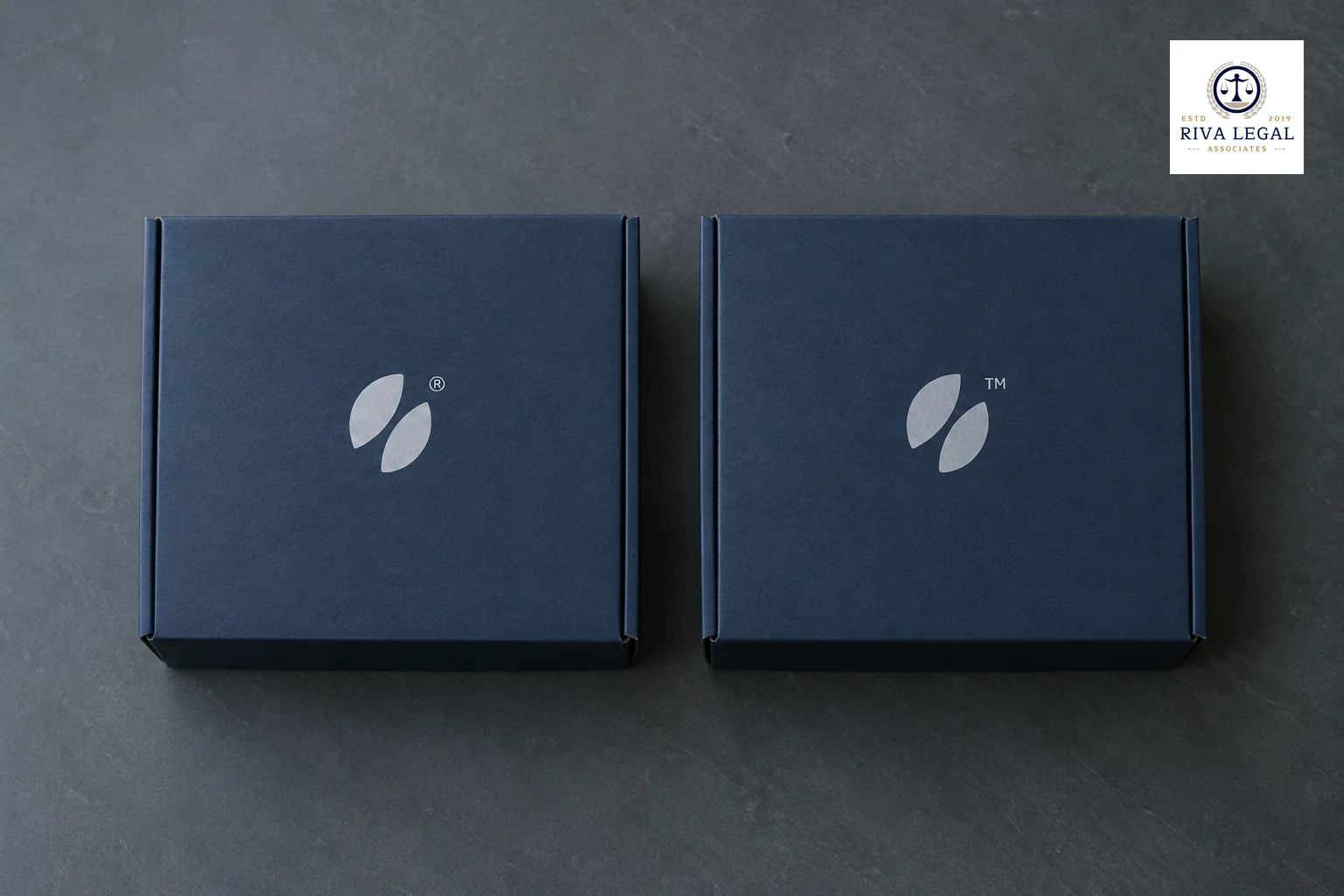
In India, the TM symbol may be used with any brand a business claims as a trade mark, whether or not it has been registered or even filed. The ® symbol is meant only for a mark that is actually registered, and only for the goods or services it covers. A pending application still takes TM. Using ® early can invite a penalty.
Key Takeaways
- TM is a claim, not a right: it tells the market you treat a name or logo as your brand. It adds no legal protection of its own and needs no permission or filing.
- ® is a statement of fact: it says the mark is registered with the Trade Marks Registry. Before the certificate is issued, the honest symbol is TM, even if your application was filed months ago.
- Scope matters: a registration covers specified goods or services only. ® beside a product outside those classes is a false statement, even if the mark is registered for something else.
- The penalty risk is real: Section 107 of the Trade Marks Act, 1999 addresses falsely representing a mark as registered. Since the Jan Vishwas amendment, reports describe a monetary penalty of up to ₹5 lakh.
- Check before you print: confirm the status, the classes and the registered form of the mark on the public register before putting ® on packaging, a website or a listing.
TM vs R Symbol at a Glance
| Point | TM symbol | ® symbol |
|---|---|---|
| What it says | "We claim this as our trade mark" | "This mark is registered" |
| Who may use it | Anyone using a mark as a brand | Only the proprietor of a registered mark |
| Registration needed | No | Yes, granted and on the register |
| Legal protection added | None by itself | None by itself; the registration carries the rights |
| Goods or services covered | Any you use the mark on | Only those in the registered classes |
| Pending application | Appropriate | Not appropriate |
| Risk if misused | Low; may mislead if the mark is plainly generic | Penalty exposure under Section 107 if the mark is not registered |

What Does the TM Symbol Signal in India?
The TM symbol signals that a business treats a word, name or logo as its trade mark. It can be used from the first day of use, with or without an application. It creates no registered rights, but it tells competitors, distributors and customers that the brand is claimed.
The Trade Marks Act, 1999 does not prescribe the TM symbol at all. That absence cuts both ways. Nobody grants you permission to use it, and nobody checks it. The general description of trademark symbols makes the same point: the sign shows that a mark is claimed as a trademark and does not indicate registration or give enhanced protection.
Why use TM at all?
The value is practical. A visible TM on packaging, an invoice header or a website footer shows that you consider the name to be a brand and not a descriptive phrase. It can discourage casual copying and helps marketplaces and distributors see which word is the brand.
The WIPO guide on making a mark notes that using ®, TM, SM or equivalent symbols is not a requirement and generally gives no further legal protection, though it can warn possible infringers. That is a fair summary of how Indian businesses should see TM: a notice, not a shield.
What about the SM symbol?
SM stands for service mark. Some businesses that sell services, such as consulting, education or hospitality, use SM in place of TM. In India both TM and SM are informal conventions with the same practical effect. Most Indian filers simply use TM for goods and services alike.
Does TM mean the brand is protected?
No. A claimed but unregistered mark is protected, if at all, through the common-law action of passing off, which depends on reputation built through actual use. Registration gives a statutory right to sue for infringement and a documented priority. The TM symbol is neither.
What Does the ® Symbol Signal in India?
The ® symbol signals that the mark is registered under the Trade Marks Act, 1999 and sits on the register in the proprietor's name. It may be used only with the goods or services listed in the registration. A pending, objected or opposed application does not qualify.
On the IP India page on trademark basics, registration is described as giving exclusive legal rights to use the mark in relation to the registered goods or services, protection against infringement and misuse, and an asset that can be licensed or assigned. The symbol is shorthand for that status.
When does a mark count as registered?
A mark counts as registered once the Registrar has accepted it, it has cleared advertisement without a successful opposition, and the registration certificate has been issued under the seal of the Trade Marks Office. Acceptance alone, or a filing receipt, is not enough.
The India IPR toolkit published by the USPTO explains that once an application meets all requirements, a certificate is issued and the registration is effective as of the filing date of the underlying application. That backdating helps priority. It does not let you use ® during the waiting period.
Under Section 25 of the Act, registration lasts ten years and can be renewed for further ten-year periods. The ® symbol is only accurate while the registration remains in force, a point covered in our note on trademark renewal deadlines and late fees.
Does ® cover the whole brand?
Not automatically. A registration is tied to the mark in the form registered and to the listed classes. A word mark registration does not by itself cover a stylised logo, and a class 25 registration for clothing does not cover cushion covers in class 24. The symbol should track the register, not the brand's general ambition.
TM vs R Symbol by Filing Stage: Comparison Table
The right symbol depends on where the brand stands on the register. The table below maps the usual stages of an Indian trade mark journey to the symbol that fits at each one.
| Stage of the brand | Symbol to use | Reasoning |
|---|---|---|
| Name chosen, not yet in use or filed | None needed, or TM once launched | Nothing is being claimed in the market yet |
| In use, not filed | TM | Claims the brand; rights rest on use and reputation |
| Application filed, awaiting examination | TM | A filing receipt is not registration |
| Examination report issued, objection pending | TM | The Registrar has not accepted the mark |
| Accepted and advertised, opposition window open | TM | A third party may still oppose |
| Registered, certificate issued, in force | ® for registered goods or services | The mark is on the register |
| Registered in some classes only | ® only with those goods or services; TM elsewhere | Registration is class-specific |
| Abandoned, refused, removed or lapsed | Stop using ®; TM only if you still claim the brand | The statement of registration is no longer true |
A hypothetical worked example
Consider a hypothetical Jaipur block-print brand called "Neelkamal" that sells kurtas and, from this year, cushion covers. It files one application in class 25 for clothing and, while waiting, prints TM on every tag, which is correct.
Once the class 25 certificate is issued, the brand may print ® on the kurta tags. It should not print ® on the cushion-cover packaging, because cushion covers fall in class 24 and no filing covers them. Those products keep TM until a separate registration is granted. Our guide to the trademark registration procedure in India sets out how the stages in the table are reached.
What Are the Risks of Using ® Before Registration?
Using ® before registration misstates the legal status of the mark. Section 107 of the Trade Marks Act, 1999 addresses falsely representing a trade mark as registered. Beyond a possible penalty, the misuse can damage credibility in a dispute and weaken the brand's position with marketplaces, buyers and the Registry.
Penalty exposure under Section 107
Section 107 was long treated as a criminal offence. The Jan Vishwas (Amendment of Provisions) Act, 2023 decriminalised many provisions of this kind. Commentary on the amendment reports that, from 1 August 2024, an adjudicating officer, being the Registrar or an authorised officer, may levy a monetary penalty of up to ₹5 lakh without going to a criminal court.
The precise mechanism and quantum are set out in the Act and in the rules notified under it. Because the position changed recently and is still being applied, anyone relying on a particular figure should read the current text of the statute and the notified rules before acting.
Practical consequences beyond the penalty
A false ® can cost a business in quieter ways. These are the risks that tend to arise in practice:
- Credibility in a dispute: if you later object to a copycat, the other side may point to your misuse of ® to question your own care with the register.
- Marketplace and distributor friction: platforms and buyers who ask for registration proof may find only a pending application behind a mark that claims otherwise.
- Misleading consumers: a registered-looking brand can suggest a level of rights that does not exist yet, which is the reason the statute treats it as a false representation.
- Wasted reprinting: packaging, labels and catalogues printed with ® too early must be corrected, often at the cost of the print run.
A related question is what you can do against a copier while your application is still pending. The answer is covered in our article on whether you can enforce a trademark before registration is done. The symbol you print does not change that analysis in either direction.
How Do You Check Status Before Choosing a Symbol?
Check status by searching the public trade mark register on the IP India website with your application number or mark, reading the status label, and confirming the classes and the form of the mark. Use ® only if the status shows the mark as registered for the goods or services you are labelling.
The steps below put the check in order, with the result that clears you to use ® and the result that does not.
- Find your application number. It appears on the filing receipt issued when the application was submitted. Without it, search by the wordmark and the applicant's name.
- Search the public register on the IP India website. The Trade Marks Registry is run under the Controller General of Patents, Designs and Trade Marks. Use the official portal, not a third-party tracker.
- Read the status label. "Registered" clears you to consider ®. Labels such as "Objected", "Accepted and Advertised", "Opposed" or "Formalities Chk Pass" mean TM only. "Abandoned", "Refused" or "Removed" mean no ®. Our explainer on what each status on the IP India portal means covers each label.
- Check the classes. The goods or services in the registered classes must match what you are labelling. If the product is outside them, use TM on that product.
- Check the form of the mark. Compare the registered representation (word, logo, or combined) with what appears on your label. Use ® with the form actually registered.
- Check the validity date. Registration runs for ten years and needs renewal. If renewal was missed and the mark has been removed, ® is no longer accurate.
- Confirm the proprietor's name. The registered owner should be the entity that sells the goods. After a sale, merger or licence, check that the assignment has been recorded.

Pass and fail criteria in plain terms
You pass the check when the status is registered, the class matches the product, the mark form matches the label and the registration is in force. You fail it if any one of those is missing. A failed check does not mean the brand is unprotected, only that TM is the accurate symbol for now.
For a pending application, the check is worth repeating at each stage. Many founders glance at the register once after filing and then never again, and so miss the day the status changes to registered.
Common Mistakes with Trade Mark Symbols
Most errors come from treating the symbol as decoration instead of a statement about the register. These are the patterns that most often cause trouble for Indian businesses.
- Printing ® on the day of filing. The filing receipt confirms the application, not the registration. TM is correct until the certificate issues.
- Using ® on a logo when only the wordmark is registered. The logo may have been left out of the application. Check whether it was filed separately, a question we discuss for fashion brands where labels and logos change often.
- Applying ® across a whole product line. A registration in one class does not extend to other categories.
- Keeping ® after lapse. If renewal was missed or the application was abandoned, the symbol should come off.
- Relying on a foreign registration. A US or EU registration does not make a mark registered in India. For Indian packaging and listings, ® follows the Indian register.
- Overusing the symbol. Repeating TM or ® beside every mention in running text adds clutter. Most brands mark the first or most prominent use on a page or label.
Founders in Jaipur and elsewhere in Rajasthan who sell through marketplaces or to distributors in other states should note that the Trade Marks Registry's records are national. The symbol you use in Jaipur is judged against the same register as one used in Mumbai or Delhi. Disputes can be raised in other states, so the position should be accurate everywhere the goods travel.
A Simple Decision Rule for Founders
If you cannot point to a registration certificate, or an entry showing "Registered" on the public register, use TM or nothing. If you can, use ® only on the goods or services in the registered classes and in the registered form of the mark.
One point is genuinely unsettled. Since the 2024 amendment, the enforcement practice for Section 107 penalties is still developing, and it is not yet clear how often or how heavily they are imposed. That uncertainty argues for caution: the cost of waiting a few more weeks to print ® is usually small, and the cost of an incorrect claim is hard to predict.
Frequently Asked Questions
Can I use the TM symbol without filing a trade mark application?
Yes. Nothing in Indian law requires a filing, a fee or permission before you use TM. It is available from the first day you use a brand in trade. It signals a claim only and adds no registered rights, so filing remains a separate step.
Can I use ® while my application is pending?
No. A pending application, even one that has been accepted and advertised, is not a registered mark. The accurate symbol is TM until the registration certificate is issued. Using ® earlier risks being treated as a false representation of registration under Section 107 of the Trade Marks Act, 1999.
Can I use ® in India if my mark is registered abroad?
Not on that basis alone. Trade mark rights are territorial, so a registration in another country does not make a mark registered in India. For goods sold in India, use ® only if the mark is registered with the Indian Trade Marks Registry for those goods or services.
Does the symbol have to be superscript or in a particular place?
No rule in the Act fixes the size or position. Convention places the symbol at the upper right of the mark, in a smaller size. What matters is that it is legible, sits next to the mark it describes, and is accurate for the status of that mark.
Do I have to use ® once my mark is registered?
No. Using ® is optional, as the WIPO guidance on symbols indicates. Registered proprietors often use it because it informs others that the mark is registered. Your rights come from the registration itself and not from displaying the symbol.
Where to Read the Primary Sources
The text that governs all of this is the Trade Marks Act, 1999, in particular Section 25 on duration and Section 107 on false representation, together with the Trade Marks Rules.
The IP India website carries the public register, forms and official fee schedules, including the official fees and forms page. Reading the current text of the Act and the register entry for your own mark is the surest way to decide which symbol applies on your facts.
This content is published for general information only. It is not legal advice, an advertisement, or a solicitation of work, and reading it does not create an advocate-client relationship. In keeping with the Bar Council of India Rules, Riva Legal Associates does not solicit work or advertise.