
What to Prepare Before an NRI Virtual Consultation for Indian Legal Matters
A Bengaluru-origin engineer now settled in Toronto once logged into a video call about her late father's Jaipur property with nothing but a phone photo of the sale deed and a vague memory of which cousin held the original papers. The consultation, scheduled for thirty minutes, stretched into ninety and still ended without a clear next step. The lawyer needed documents that simply were not in the room. This is the quiet cost of walking into an NRI virtual consultation for Indian legal matters unprepared: not a wasted call, but a wasted first impression of the case itself.
Virtual consultation has already helped non-resident Indians dealing with property disputes, business filings, or inherited litigation back home connect with counsel across distance. What it has not solved automatically is preparation. A screen can carry a conversation across time zones, but it cannot substitute for the right documents, the right questions, and a clear sense of which Indian jurisdiction actually governs the matter. This guide sets out what to have ready before that call, so the time with counsel goes toward strategy rather than scrambling for paperwork.
Why Preparation Matters More When the Meeting Is Remote
An in-person meeting at a law office in Jaipur or Delhi allows for a follow-up visit the next morning if a document is missing. A video call from London, Dubai, or San Francisco does not have that luxury. The time zone gap between India and most NRI destinations means a gap of eight to fourteen hours before the next real-time conversation is possible. Every missing document or unanswered question can add a full day, sometimes more, to the timeline.
Counsel working across borders can generally give a more precise, actionable opinion when they see the actual paperwork, not a description of it. A well-prepared client is more likely to walk away from a single session with a clearer view of the legal position, the documents still needed, and the realistic next steps. An unprepared one often needs a second call just to establish facts that could have been sent over in advance. The checklist below is built around that gap.
1. Gather the Core Documents Before You Log In
Start by separating documents into categories relevant to the matter at hand. Most NRI legal queries fall into property, business or intellectual property, and contractual categories, and each has its own paper trail.
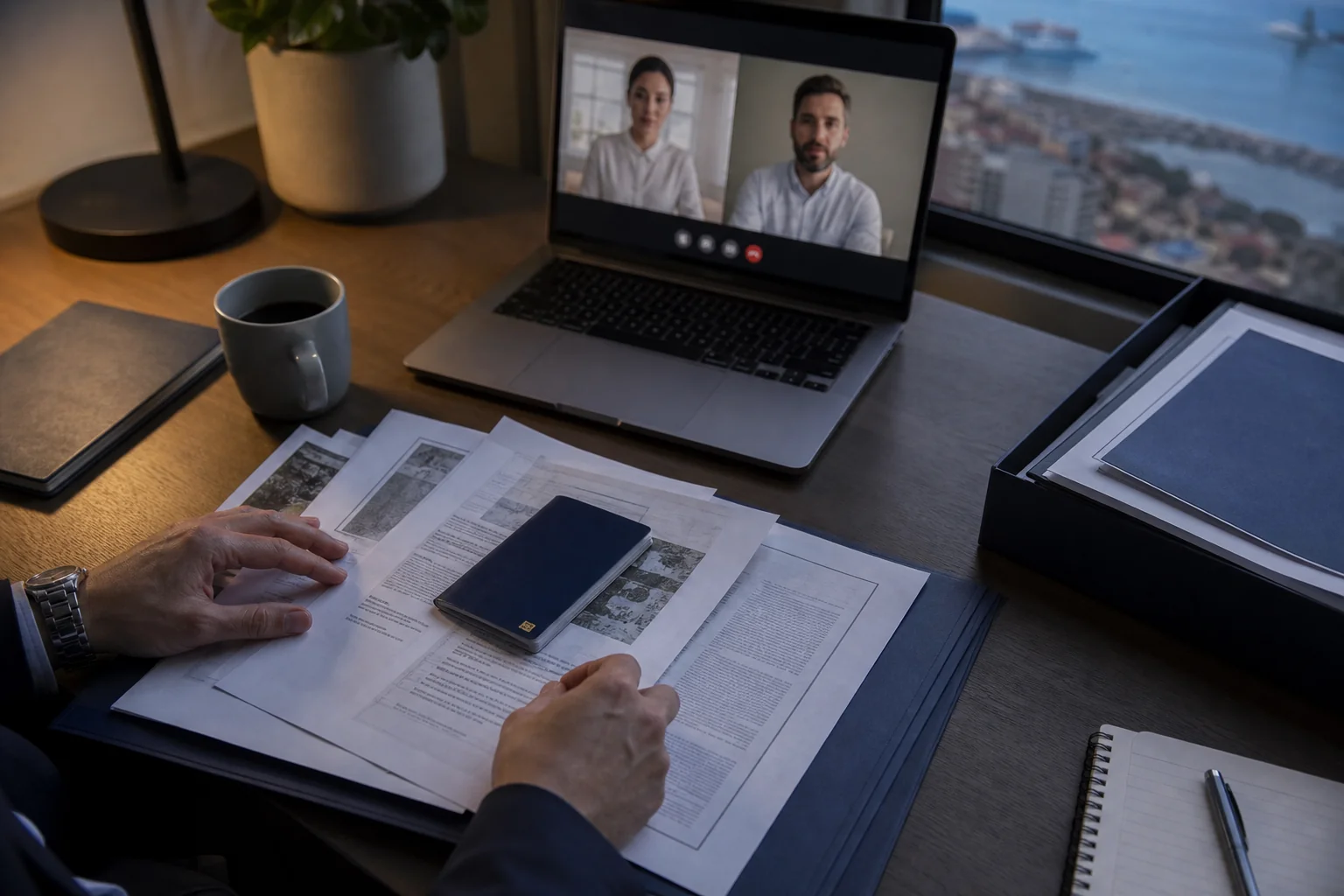
Identity and Status Documents
- Passport (all pages showing entry/exit stamps if immigration history is relevant)
- OCI or PIO card, if applicable
- PAN card, especially for any matter touching property, tax, or company shareholding in India
- Proof of current overseas address (utility bill, residency permit, or similar)
Property-Related Papers
- Original or certified copy of the sale deed or gift deed
- Encumbrance certificate showing the chain of title
- Mutation records and latest property tax receipts
- Any will, succession certificate, or partition deed already in existence
Business and IP Papers
- Certificate of incorporation, MOA/AOA, or partnership deed
- Trademark, patent, copyright, or design filing receipts and correspondence from the Indian IP office
- Any founders' agreement, licensing agreement, or NDA already signed
Correspondence and Prior Legal Opinions
If the matter has already generated a legal notice, a court order, or a previous lawyer's opinion, have all of it scanned. Counsel needs to know what has already been said and done before advising on what to do next. Skipping this step is one of the common reasons a first consultation ends inconclusively.
Scan everything as PDF, name each file clearly (for example, "Sale_Deed_2011_Jaipur.pdf" rather than "IMG_2041.pdf"), and organise them into a single shared folder or email thread before the call. If the matter involves trademark or patent protection specifically, it helps to review how trademark registration works for founders in India or how design registration is handled for Indian products beforehand, so the questions raised on the call are specific rather than exploratory.
2. Decide What Kind of Power of Attorney You May Need
Many NRI matters cannot move forward without someone in India authorised to act on the client's behalf, whether that is signing a sale deed, appearing before a sub-registrar, or representing the person in a routine hearing. This is where a power of attorney (POA) becomes central to the discussion.
There are two broad types worth understanding before the consultation:
- General Power of Attorney (GPA) - authorises an agent to act across a wide range of matters, useful when ongoing management of property or business affairs is needed.
- Special or Specific Power of Attorney (SPA) - limited to a single transaction, such as executing one sale deed or representing the principal in one specific case.
Execution procedure differs depending on where the NRI is signing from. A POA signed outside India typically needs to be notarised locally and then either apostilled (for countries under the Hague Apostille Convention) or attested by the Indian embassy or consulate in that country. Once it reaches India, a POA dealing with immovable property generally needs to be stamped and, in many states, registered with the local sub-registrar within a stipulated period from receipt. An unattested or unregistered POA is a frequent reason a bank, sub-registrar, or court clerk declines to act on it, which can complicate months of remote coordination.
Before the consultation, note down: which country the POA will be executed in, what the agent is expected to do with it, and whether the underlying transaction involves property (which usually triggers registration requirements) or a more limited business or litigation task. Bringing these specifics to the call lets counsel discuss the correct format on the call rather than in a follow-up email days later.
3. List the Jurisdiction-Specific Questions to Raise
One detail that surprises many NRIs is that their own place of residence abroad has almost no bearing on which Indian court or authority handles their matter. Jurisdiction in India is generally tied to where the property sits, where the cause of action arose, or where the business or IP filing was made, not where the client currently lives.

Property Disputes
A flat in Jaipur, a farmhouse in Udaipur, or an ancestral property in a village in Rajasthan will each generally fall under the civil court and revenue authority of that specific district, regardless of whether the owner lives in Houston or Melbourne. Ask counsel to confirm the exact forum, the applicable state stamp duty and registration rules, and whether any limitation period is running on a claim.
Intellectual Property Matters
For a trademark or patent, jurisdiction typically follows the appropriate IP office where the application was filed (Delhi, Mumbai, Kolkata, or Chennai, for the Trade Marks Registry, for instance) and, for disputes, the commercial court empowered to hear IP matters in that region. An NRI founder running a business partly from abroad should ask specifically how copyright registration or trademark enforcement proceeds when the rights holder is not physically present in India for hearings.
Cross-Border Contracts and Enforcement
If the matter involves a contract signed abroad but meant to operate in India, or a dispute where a foreign judgment needs recognition in Indian courts, this is a distinct and technical area. Ask counsel directly how enforcement would work, what reciprocal arrangements (if any) apply between India and the country where the NRI resides, and whether arbitration or civil litigation is the more realistic route.
Matters Spanning More Than One State
It is common for an NRI's affairs to touch more than one Indian state at once, a property dispute in Rajasthan alongside a trademark opposition filed in Delhi, for example. Ask whether the firm can coordinate representation across states directly or whether separate local counsel will be needed in each location, since this materially affects both cost and the number of relationships the client has to manage remotely.
4. Prepare a Clear, Written Timeline of Events
Before the call, write out a simple chronology: date of purchase or filing, date of any notice received, date of any prior legal opinion, and any deadline currently in motion. This kind of document often helps a consultation move efficiently, because it lets counsel see the shape of the problem quickly rather than reconstructing it through questions.
Flag limitation periods specifically. Indian law imposes strict time limits for filing many types of claims, from property suits to IP oppositions, and a matter that looks straightforward can become urgent once the relevant limitation period is identified. If a notice or deadline has already been received, mention the exact date in the first message to the firm, not partway through the call.
5. Sort Out the Practical Side of the Call Itself
A number of virtual consultations lose ten or fifteen minutes to avoidable friction: a miscalculated time zone, an unfamiliar video platform, or uncertainty about who else should be present. None of this is legal work, but all of it eats into the time meant for legal work.
- Confirm the time zone conversion in writing with the firm ahead of the call, rather than relying on a calendar app that may default to the wrong zone.
- Test the video and document-sharing platform a day in advance if it is unfamiliar, particularly where the connection quality abroad is inconsistent.
- Decide in advance who else needs to join, a co-owner of the property, a spouse who is also on the title, or a business partner with a stake in the IP matter. Adding a participant mid-call often means repeating the first fifteen minutes.
- Ask how confidentiality is maintained over video. A firm should be able to explain how privileged communication is handled, how documents are stored, and who within the firm has access to the file.
6. Questions Worth Asking During the Consultation
The consultation itself is the place to test assumptions rather than confirm them silently. A few questions are worth raising directly, regardless of the type of matter:

- Is a power of attorney sufficient, or will personal presence be required at some stage? Some hearings, registrations, or bank formalities still require the NRI to appear in person or through a specific authorised representative, and it helps to know this before assuming the matter can be handled entirely from abroad.
- What is a realistic timeline given that coordination may span multiple states or involve associated local counsel?
- How is the engagement structured, a one-time advisory opinion, a document review, or an ongoing retainer? For NRIs with a single, contained issue, a one-time contract or document review is often more appropriate than a full retainer, while founders managing recurring filings across jurisdictions may benefit more from outsourced general counsel arrangements.
- What will the fee estimate look like for the specific stage being discussed, and does it change if the matter proceeds to litigation or a contested filing?
Asking these questions early, rather than after receiving an engagement letter, can help avoid renegotiating scope later in the relationship.
Common Situations NRIs Bring to a Virtual Consultation
While every matter is specific, a few categories recur often enough to be worth naming directly:
- Property inheritance and partition disputes, particularly where multiple heirs are spread across India and abroad, and one sibling is managing the property locally while others are not.
- Trademark or patent protection for a business that the NRI runs partly or fully from overseas but sells into the Indian market, where sector-specific filing strategy matters alongside the filing itself.
- Contract or agreement review before signing, especially for NRIs investing in Indian real estate or a family business remotely, where a clause quietly shifting liability can be easy to miss without local legal context.
- Trade secret and licensing concerns when a founder relocates abroad but the company's core operations, or its confidential know-how, remain in India.
Rivalegal, an intellectual property practice based in Jaipur, works with NRI clients across several of these categories, coordinating with associated local counsel where a matter touches more than one Indian state. The firm's IP practice page outlines the specific areas of patent, trademark, copyright, design, and trade secret work handled for both resident and non-resident clients.
Frequently Asked Questions
Can a power of attorney be executed entirely outside India?
Yes, in most cases. It is typically signed before a notary in the NRI's country of residence and then either apostilled or attested by the Indian embassy or consulate there, depending on whether that country is party to the Hague Apostille Convention. Once it arrives in India, it may still need local stamping and registration, particularly for property transactions.
Is a virtual consultation legally valid for matters heading to an Indian court?
A virtual consultation itself is simply a form of client communication and does not, by itself, replace formal court procedure. Actual filings, appearances, and hearings follow the applicable rules of the specific court or tribunal, which may permit virtual appearance in some circumstances and require physical presence in others. Ask counsel directly how this applies to the specific forum involved in the matter.
Do NRIs need to be physically present for property registration in India?
Not necessarily. A validly executed and registered power of attorney can often allow an authorised agent to complete registration formalities on the NRI's behalf, though requirements vary by state and by the nature of the transaction. This is a key question to raise directly during the consultation, since assuming remote handling is always possible can lead to delays discovered too late.
How is confidentiality maintained during a video legal consultation?
A properly conducted consultation should generally follow the same confidentiality and privilege standards as an in-person meeting, meaning documents shared over video or email are intended to be handled under attorney-client privilege and stored securely within the firm. It is reasonable to ask any firm directly how they handle document storage and access before sharing sensitive papers.
Bringing It Together Before the Call
The value of a virtual consultation depends largely on what arrives with the client, not only the platform used to conduct it. Scanned documents organised by category, a clear view of what kind of power of attorney the matter requires, a written timeline of events, and a short list of jurisdiction-specific questions can help move an NRI legal matter forward in one sitting.
Riva Legal Associates is an intellectual property practice at Jagatpura, Jaipur, Rajasthan, led by Richa Vaishnav, advocate. The areas of practice handled by the firm are listed on its practice areas page.
This article is published for general information only. It is not legal advice, an advertisement, or a solicitation of work, and reading it does not create an advocate-client relationship. In keeping with the Bar Council of India Rules, Riva Legal Associates does not solicit work or advertise. Statutory fees, forms and timelines change; verify current requirements with the Office of the Controller General of Patents, Designs and Trade Marks before acting, and consult a qualified advocate on your own facts.