
Trademark vs Copyright Registration in India: Which Applies?
A logo can be protected two different ways at once: as an artistic work under copyright the moment it is drawn, and as a brand identifier under trademark law once it is registered to distinguish goods or services. The trademark registration vs copyright registration question in India usually comes down to one thing: is the object being protected an identifier used in trade, or an original piece of creative expression?
Key Takeaways
- Different statutes, different subject matter: Trademark registration falls under the Trade Marks Act, 1999, and protects brand names, logos, taglines and similar identifiers used to distinguish goods or services in trade.
- Copyright arises automatically: Under the Copyright Act, 1957, copyright exists from the moment an original literary, artistic, musical or dramatic work is created; registration is optional and creates a public record, not the right itself.
- A single logo can need both: The artistic design of a logo may carry copyright as a drawing, while its use as a source identifier for a business requires separate trademark registration.
- Timelines diverge: Trademark applications go through examination, journal publication and a statutory opposition window before registration; copyright applications generally follow a different administrative path without an equivalent opposition stage.
- The decision is about function, not preference: Businesses do not choose between the two registers on convenience; the nature of the asset (identifier versus expression) generally decides which filing is relevant, and often both are.
At a Glance: Trademark vs Copyright Registration
The table below sets out the core statutory differences a business owner or creator typically needs before deciding which filing applies to a given asset.
| Aspect | Trademark Registration | Copyright Registration |
|---|---|---|
| Governing statute | Trade Marks Act, 1999 | Copyright Act, 1957 |
| What it protects | Brand names, logos, taglines, sounds and other marks used to identify goods/services in trade | Original literary, dramatic, musical and artistic works, software, films, sound recordings |
| When the right arises | Only on registration (though unregistered use can support a passing-off claim) | Automatically on creation of the work, fixed in a tangible form |
| Registration mandatory? | Not mandatory, but registration is generally required to sue for infringement | Not mandatory; registration is a public record, not a precondition of the right |
| Approximate process stages | Search, filing, examination, journal publication, opposition window, registration | Filing, examination, and registration, without a public opposition stage of the same kind |
| Term of protection | 10 years from filing, renewable indefinitely in further 10-year terms | Generally the author's lifetime plus 60 years for most works (varies by work type) |
| Governing authority | Trade Marks Registry, under the Controller General of Patents, Designs and Trade Marks | Copyright Office, under the Department for Promotion of Industry and Internal Trade |
What Trademark Registration Protects Under the Trade Marks Act, 1999
Trademark registration in India protects marks used to distinguish one business's goods or services from another's. This includes brand names, logos, taglines, and in some cases sounds or colour combinations, provided the mark is distinctive and used, or intended to be used, in trade.

The filing process runs through several stages: a preliminary search of existing marks, filing the application in the correct class under the NICE Classification, examination by the Trade Marks Registry, publication in the Trademarks Journal, and a four-month window during which third parties may oppose the mark before registration is granted. A registered trademark under the Act lasts ten years from the date of filing and can be renewed indefinitely, ten years at a time, so long as renewal fees are paid on time.
For businesses evaluating which classification and process steps apply to a specific brand name or logo, a fuller walkthrough is available in the trademark registration procedure guide, and the class selection question is addressed separately in the NICE Classification guide.
What Copyright Registration Protects Under the Copyright Act, 1957
Copyright protects original literary, dramatic, musical and artistic works, along with cinematograph films, sound recordings and computer software, once the work is fixed in a tangible or recorded form. Unlike a trademark, the right does not depend on filing anything.

Copyright arises the moment the work is created, provided it is original. Registration with the Copyright Office is a separate, voluntary step. It does not create the right, but it produces a dated, official record of authorship that can carry weight if ownership is ever disputed in court. Protection for most categories of work generally runs for the author's lifetime plus sixty years, a term set out in the Act itself and distinct from the fixed, renewable ten-year cycle that applies to trademarks.
A step-by-step account of the registration process, including the documents typically required, appears in the guide to registering copyright for creative work in India.
Does a Logo Need a Trademark, a Copyright, or Both?
A logo often needs both a trademark and a copyright, because the two rights protect different aspects of the same object: one protects it as a drawing, the other protects it as a brand signal.
As an artistic work, a logo's design attracts copyright from the moment it is drawn, whether or not it is ever used commercially. Once the same logo is put into use to identify a business's goods or services, a separate question arises: does a competitor's similar mark, on similar goods, create confusion in the market? That question is answered by trademark law, not copyright law, and it is trademark registration, not copyright registration, that generally supports an infringement action over brand confusion.
This is why a business commissioning a logo from a designer typically needs a written assignment of copyright in the design, alongside a separate trademark application once the logo goes into commercial use. Skipping either step leaves a gap: copyright without trademark protection does little to stop a competitor from adopting a confusingly similar brand mark, and trademark registration alone does not settle who owns the underlying artwork if the designer relationship ends in a dispute.
How Do the Registration Timelines Compare?
Trademark registration in India generally takes longer than copyright registration, mainly because of the mandatory four-month opposition window built into the trademark process, which has no direct equivalent under the Copyright Act.
An unopposed trademark application can still take a considerable number of months to move through search, examination, publication and registration, a timeline set out in more detail in the trademark procedure guide. Copyright applications move through the Copyright Office's own examination process without a public objection period of the same kind, though processing times still vary based on the completeness of the application and the category of work being registered.
Which One Applies to a Brand Name, a Slogan, or a Creative Work?
A brand name or slogan used to sell goods or services generally calls for trademark registration, because its function is to identify the source of a product in the marketplace. A book manuscript, a piece of software code, an illustration, or a musical composition generally calls for copyright, because its function is creative expression rather than source identification.
The distinction gets less clean in practice. Product packaging, for instance, often combines a brand name (trademark), original artwork (copyright), and sometimes a distinctive three-dimensional shape or surface pattern (design registration under the Designs Act, 2000, a third and separate register). A business preparing a product launch may need to look at all three registers rather than assume one filing covers everything, a point addressed at length in Trademark vs Copyright vs Patent: What Your Business Needs, which sets out the broader three-way framework including patents for underlying inventions.
Where the asset in question is a product's shape or ornamentation rather than its brand name or artistic content, that generally sits under design registration instead, covered separately in the guide to design registration in India.
Common Situations for Jaipur and Pan-India Businesses
A Jaipur-based apparel, jewellery or handicraft business often needs both registers at once, not as a matter of preference but because the two assets involved are legally distinct.
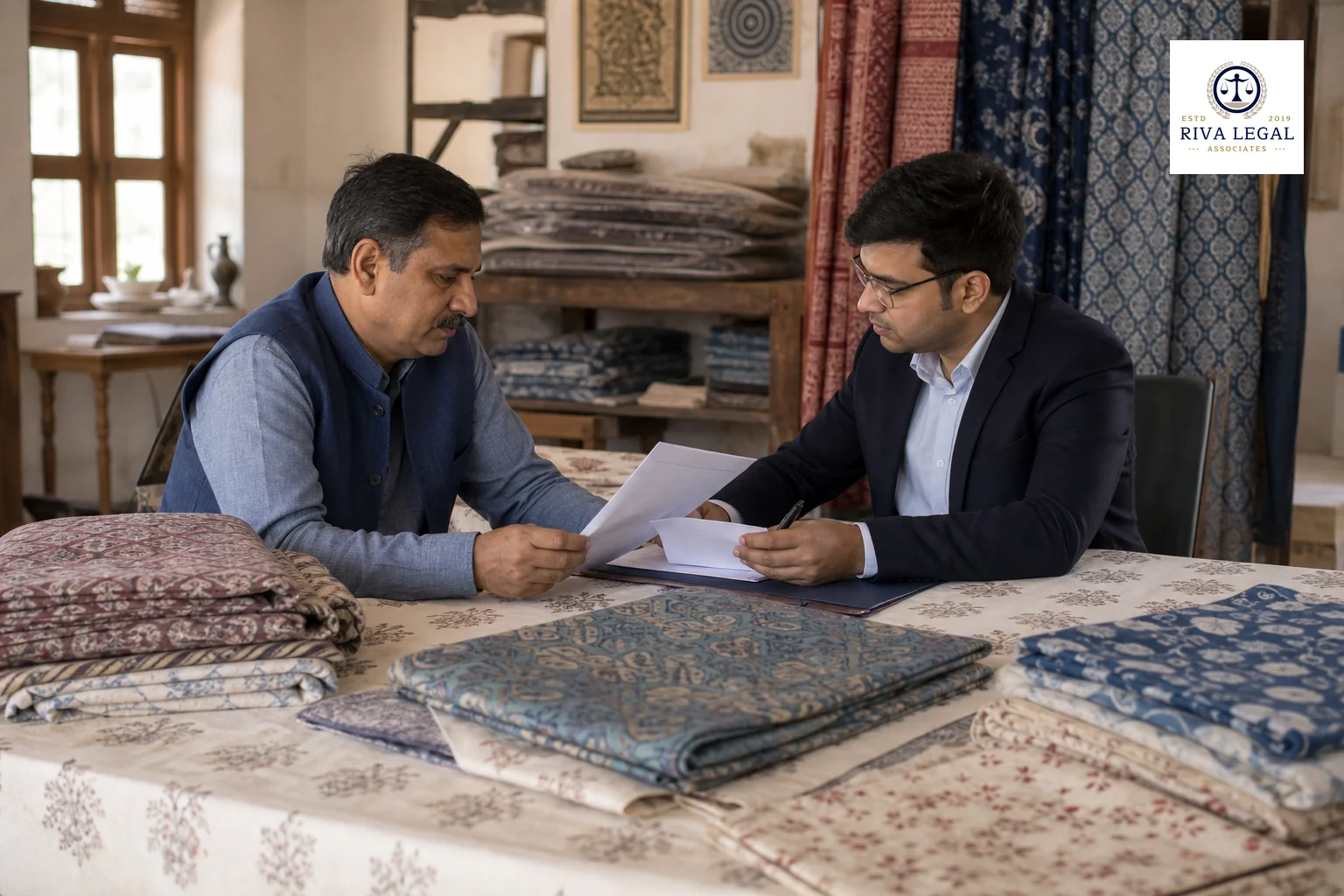
A brand name stitched onto a garment label needs trademark protection to stop other sellers from using a confusingly similar name on similar goods, in Jaipur's market or elsewhere in India. A distinctive block-print pattern or hand-drawn motif used across a product line may separately attract copyright as an original artistic work, and in some cases design registration if the pattern is applied industrially to the product's surface. Businesses selling across state lines face an additional practical question: enforcement of either right in a dispute may require coordinated representation in more than one state, an issue examined in the context of trademark registration costs and fee structures and in resources on multi-state coordination generally.
NRIs and businesses operating remotely face a parallel set of questions when deciding which filings to prioritise from outside India, a topic covered in what to prepare before an NRI virtual consultation for Indian legal matters.
How Is the Decision Actually Made?
The decision starts with identifying what is actually being protected: an identifier used to distinguish goods or services in trade, or an original work of authorship. Most brand-building activity in India involves both types of assets at the same time, not one or the other.
A founder designing a new logo, writing product descriptions, and choosing a brand name for launch is generating trademark subject matter and copyright subject matter simultaneously. Filing only for the one that feels more urgent, usually the trademark, leaves the artistic and written elements of the brand without a formal registration record, even though the underlying copyright already exists automatically. Businesses expanding into product design also need to check whether a separate design registration or a geographical indication filing applies, particularly for regionally distinctive crafts.
What remains genuinely unsettled in many of these cases is not the law itself but the sequencing: whether to file the trademark first and copyright later, or the reverse, often depends on which asset faces earlier commercial exposure, and that is a fact-specific judgment rather than a fixed rule.
Frequently Asked Questions
Can copyright be used instead of trademark registration for a brand name?
Copyright does not generally substitute for trademark registration when the goal is to stop others from using a similar brand name on similar goods, because copyright protects the artistic or literary expression of a work, not its function as a source identifier in trade.
A brand name written in a stylised font may attract limited copyright in the stylisation itself, but that does little to prevent a competitor from using the same or a similar word mark in a different typeface for competing goods. Trademark registration under the Trade Marks Act, 1999 is the register designed for that specific concern.
Is copyright registration mandatory in India?
Copyright registration is not mandatory in India. The right exists automatically once an original work is created and fixed in a tangible form, under Section 13 of the Copyright Act, 1957.
Registration is a voluntary additional step that creates an official, dated record of authorship. Many creators and businesses register works anyway because the certificate can be useful evidence of ownership if a dispute over authorship or copying arises later.
Can one asset be protected under both trademark and copyright law at the same time?
Yes, a single asset such as a logo can be protected under both laws simultaneously, because trademark and copyright protect different attributes of the same object rather than competing for the same right.
Copyright protects the logo as an original artistic drawing from the moment it is created. Trademark registration separately protects the same logo's function as a source identifier once it is registered and used in trade. Neither filing displaces the other.
What happens if a business only files one type of registration?
Filing only one type of registration leaves the other asset without formal protection, though copyright still exists automatically even without registration, while unregistered trademark use may still support a passing-off claim in limited circumstances.
A business that registers only its trademark but never formalises ownership of commissioned artwork, for example, may face ownership disputes with a designer later. A business that relies only on copyright for its brand name generally has a weaker position against a competitor using a similar mark, because copyright does not address market confusion between brands the way trademark law does.
Where the Analysis Fits Alongside Other IP Filings
The trademark-versus-copyright decision is one part of a broader IP framework that also includes patents, industrial designs, geographical indications and trade secrets, each governed by its own statute and each protecting a distinct type of asset. Readers weighing the full range of options can refer to the broader comparison set out in Trademark vs Copyright vs Patent: What Your Business Needs for the three-way framework, or the firm's blog for additional filings-specific guides.
For general context on how Indian statutes treat these categories, the Department for Promotion of Industry and Internal Trade publishes consolidated guidance on IP frameworks at dpiit.gov.in, and the statutory text of the Trade Marks Act, 1999 and the Copyright Act, 1957 is available through the India Code portal maintained by the Ministry of Law and Justice.
This content is published for general information only. It is not legal advice, an advertisement, or a solicitation of work, and reading it does not create an advocate-client relationship. In keeping with the Bar Council of India Rules, Riva Legal Associates does not solicit work or advertise.